
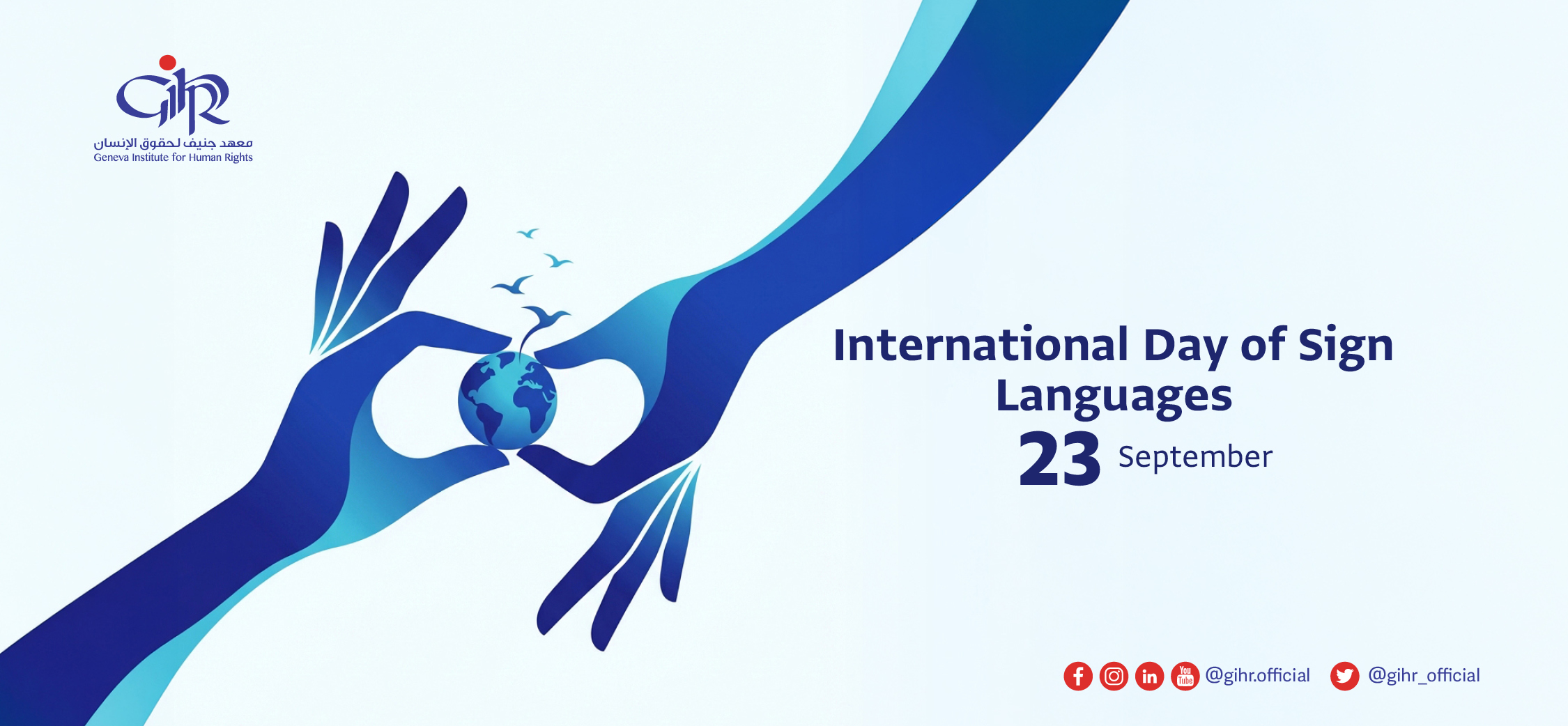
23 September 2026
Every year on 23 September, the world observes the International Day of Sign Languages, reaffirming the importance of sign languages in ensuring the full and equal enjoyment of human rights by deaf people, promoting their meaningful participation in society, and protecting their linguistic and cultural identity.
The Geneva Institute for Human Rights emphasizes that sign language is not merely a means of communication. It is a natural language and a fundamental right closely connected to access to education, healthcare, justice, information, public services, freedom of expression and participation in public life.
The 2026 International Day of Sign Languages is observed under the theme “Realising the Human Rights of Deaf People,” highlighting the need to move from recognizing rights in principle to ensuring their effective realization in everyday life.
The Institute stresses that equality and inclusion require removing barriers that prevent deaf people from accessing information, services and opportunities on an equal basis. This includes providing appropriate interpretation, communication services and reasonable accommodations, particularly in education, healthcare, justice and public services.
The Institute also emphasizes the importance of protecting sign languages as part of linguistic and cultural diversity and ensuring the meaningful participation of deaf people and their representative organizations in the development of policies and decisions affecting their rights.
In this context, the principle of “Nothing About Us Without Us” remains essential to ensuring that deaf people are not only beneficiaries of policies, but active participants in shaping the decisions that affect their lives.
The Geneva Institute for Human Rights reaffirms its commitment to promoting equality, non-discrimination, accessibility and the full realization of the rights of deaf people, contributing to the building of inclusive societies where everyone can participate with dignity and on an equal basis.
Sign language is a right, and ensuring equal access, participation and dignity is a shared human rights responsibility.