
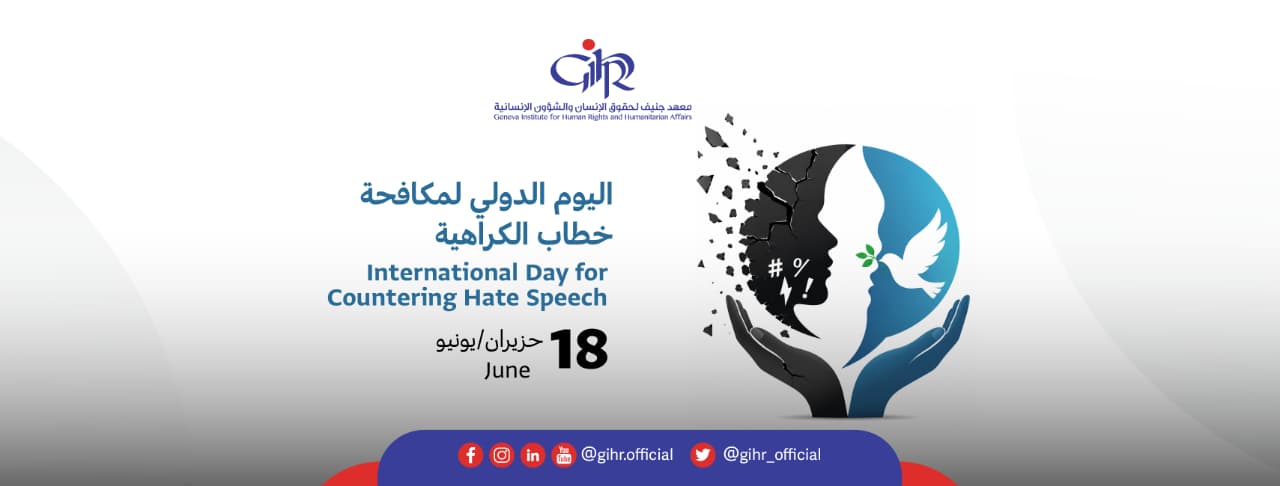
GIHR Statement on the International Day for Countering Hate Speech 2026
On the International Day for Countering Hate Speech, GIHR Calls for Stronger Legal Frameworks and Sustained Commitment to Human Dignity
The Geneva Institute for Human Rights and Humanitarian Affairs reaffirms its commitment to combating hate speech and protecting the rights and dignity of all persons, without discrimination.
On the occasion of the International Day for Countering Hate Speech , 18 June 2026, the Geneva Institute for Human Rights and Humanitarian Affairs reaffirms its firm commitment to combating all forms of hate speech and to protecting the dignity and rights of every person, without discrimination.
The International Day for Countering Hate Speech is observed annually on 18 June, following its proclamation by the United Nations General Assembly in July 2021. The Assembly expressed deep concern over the rapid spread and proliferation of hate speech worldwide and adopted a resolution on promoting interreligious and intercultural dialogue and tolerance in countering hate speech. The date was chosen in reference to the UN Strategy and Plan of Action on Hate Speech, which was launched on 18 June 2019,the first system-wide UN initiative designed to address this phenomenon and provide a framework for supporting and complementing Member States’ efforts.
This year’s commemoration comes as digital platforms continue to amplify hateful narratives at unprecedented scale, with documented and direct links to discrimination, violence, and the erosion of the social fabric. Research indicates that hate speech has been a contributing factor in the majority of documented cases of mass atrocities and genocide in recent decades. Despite growing international awareness, legal and institutional responses remain fragmented, and access to remedies,particularly for the most vulnerable,is far from guaranteed.
International data show that minorities, women, migrants, and persons with disabilities bear a disproportionate burden of targeted hate speech, both online and offline. Children are increasingly exposed to harmful content and cyberbullying, a risk that is further compounded by the growing use of artificial intelligence. Recognizing this, the UN calls on governments, international organizations, civil society groups, and individuals to organize events and initiatives that promote strategies for monitoring, addressing, and countering hate speech.
Countering hate speech is not a matter of restricting legitimate expression. It is a matter of protecting people from language that dehumanizes, excludes, and incites harm. This requires coherent legislative frameworks aligned with international human rights standards, independent and effective institutions, robust digital governance mechanisms, and the meaningful participation of affected communities in shaping responses.
The Geneva Institute stresses that sustainable solutions must address root causes, including structural inequality, impunity, and the normalization of discriminatory narratives. The UN Strategy and Plan of Action on Hate Speech emphasizes the importance of partnerships across all sectors of society, noting that hate speech affects the entire social fabric and therefore demands a whole-of-society response. This includes investment in education, media literacy, digital monitoring, and data collection, as well as strengthening judicial and institutional capacity and ensuring that protection mechanisms are accessible to all.
On this occasion, the Geneva Institute for Human Rights and Humanitarian Affairs calls on States, international organizations, technology platforms, and civil society to strengthen legal and institutional frameworks for countering hate speech in accordance with international human rights law; to ensure accountability for incitement to discrimination, hostility, and violence, including in digital spaces; to invest in education and prevention programs that build societal resilience and promote tolerance, critical thinking, and respect for human dignity; and to ensure that justice mechanisms are accessible to all victims of hate speech, particularly those from marginalized communities.
Whether as Member States, private sector actors, media institutions, religious leaders, educators, civil society organizations, or individuals, we all bear a moral responsibility to speak out against hate speech and play a decisive role in countering it. The International Day for Countering Hate Speech is a reminder that silence is not neutrality. Words shape reality, and the responsibility to ensure they protect rather than harm belongs to all of us.