
Geneva Institute for Human Rights and Humanitarian Affairs
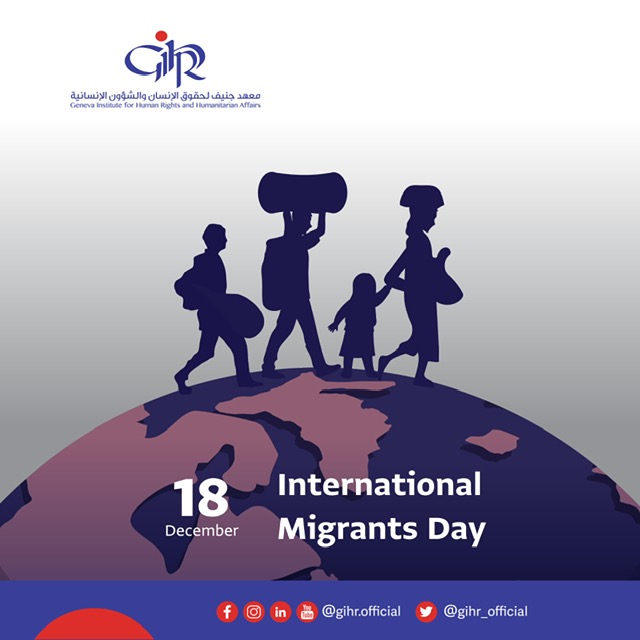
On the occasion of the International Migrants Day
The eighteenth of December of each year marks the International Migrants Day, a day proclaimed by the United Nations General Assembly in 2000 as an international day for migrants. It also coincides with the adoption of the International Convention on the Protection of the Rights of All Migrant Workers and Members of Their Families, underscoring the importance of safeguarding their dignity and ensuring their human rights.
The world has become increasingly aware of the phenomenon of migration, which continues to grow year after year, driven by the innate human aspiration for a better life, the pursuit of a decent standard of living, and the need to confront adverse conditions. Migration is an ancient human phenomenon, intrinsically linked to the existence of humankind on this earth, and it will continue as long as humanity endures. From this perspective, migration has garnered the attention of the global conscience, represented by the United Nations system, which has devoted numerous documents, programmes, and activities to migration issues and the rights of migrants, as well as to the economic and social impacts arising therefrom, whether in countries of destination, transit, or origin.
According to the latest statistics issued by the United Nations, the number of international migrants has witnessed a marked increase, rising from approximately 175 million people in 2000 to nearly 281 million people worldwide, representing about 3.6 per cent of the global population. According to the *World Migration Report 2024* issued by the United Nations’ International Organization for Migration, and the *International Migration Outlook 2025* issued by the Organisation for Economic Co-operation and Development (OECD), international migration flows have reached their highest levels in modern history, as a result of economic disparities, wars and armed conflicts, political instability, as well as the repercussions of the climate crisis.
Studies and statistics further indicate that, should migration continue at the same pace observed over the past two decades, the number of migrants worldwide is expected to reach approximately 405 million by the year 2050.
Data from the Office of the United Nations High Commissioner for Refugees (UNHCR) also show that the number of forcibly displaced persons worldwide reached 117.3 million as of June 2025, including 67.8 million internally displaced persons, 42.5 million refugees, and 8.42 million asylum seekers seeking international protection.
With this growing increase in the number of migrants, the need to ensure and protect their rights becomes ever more pressing, particularly in light of the racism, xenophobia, and various forms of discrimination to which some migrants are subjected, whether in developed or developing countries. This is in addition to their exposure, at times, to excessive violence, or their falling victim to networks of human trafficking, smuggling, and organized crime.
As the Geneva Institute for Human Rights and Humanitarian Affairs commemorates this important international occasion, it recognizes that the Middle East and North Africa region is among the regions that are simultaneously major sources and destinations of migrants, a reality that places upon the Institute a heightened responsibility to work tirelessly to promote a culture of human rights and migrant rights as widely as possible. On this occasion, the Institute renews its firm commitment to working for the protection of migrants’ rights and the preservation of their dignity, sparing no effort in pursuit of this goal.
Together, we can continue working to build a world in which migration is safe, orderly, and fair, and a source of mutual benefit for all.